What Language Beauty or Dog Whistle Are You Willing to Hear?
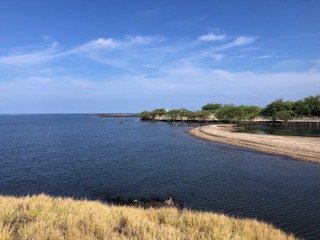
If a woman devotes her life to another woman for frolic, finance and fortitude—how do we call her? Fierceness is all I have while searching for an answer. A few luxuries are here too during early-morning research like my comfortable seat on a bench absorbing much Spencer Beach Park goodness. A breezy-soft warm wind blankets all around. The ocean shoreline tide, a few steps away, keeps shifting colors: sandy beige to aqua clear and darkly green. Nature’s sensory cinematic has a free show this morning—and every day all during the usual 24 hours.
Another time reference is in the works because we know elliptical means indirect or instead of a direct circle a stretch of an oval like how planets travel through space, and, well, time. Those planets travel just as elliptically as we humans on earth like how many days you now indirectly have to postpone reading blog essays here. We’ve gone weekly.
Fridays around lunchtime Hawaii Standard Time, not a precise timing post because elliptical on a delicious lunch I am not. No postponing healthy food just for your reading’s sake. Go ahead though, imagine briefer time (just those seven days) to procrastinate and that’s all you. Meanwhile a writer writes and a reader reads any ‘ol damn time she wishes.
A few minutes ago, walking on a path again to Pu’Ukohola Heiau National Historic Site I looked over to the shark bay. None this morning and I indulged an interior minute time-wandering to imagine when whales breaching (spinning entire selves into the air simply for playful) will happen January through March this year, like every year, in waters close to where I am sauntering. Pu’Ukohola means hill of the whale in Hawaiian.
Why I returned is to review what I learned recently last visit a week ago: how women (wahine) appear on the knowledge signs provided. A historical context fact is that a caste system called kapu organized lives on Hawaiian archipelago lands from 1200 AD until 1819 when abolished. Violently strict, one hierarchy was that men and women were not allowed to have food at the same table. Learning this I wondered how to call a woman, seen through history’s lens, if fortuitously sequestered so she was given space to be in relationship with another woman? Perhaps the National Historic Site educational signs along the pathway might help?
How might I address her respectfully? Who I found was Queen Emma born 1850 or so at Pelekane, a kapu restrictive social compound near Pu’Ukohola Heiau. Mention of the Queen and her devotion to a woman are not appearing in the historical archaeology so far. Reading like a word-detective what I see next is a discovery: King Kamehameha I, known for unifying Hawaiian Kingdom islands through strategic violent-war decisions, and peaceful negotiations in 1810 for annexing Kauai, had a daughter, Kamamalu, born at Pelekane in 1802. Her mother Kalākua Kaheiheimālie, who earned political power in Hawaii for several decades, is not mentioned on the National Historic Site knowledge sign. My word-search continues after I quietly give thanks for another walk on a history path, feeling inspired for a modern chance to be in knowledge and curious on omissions.
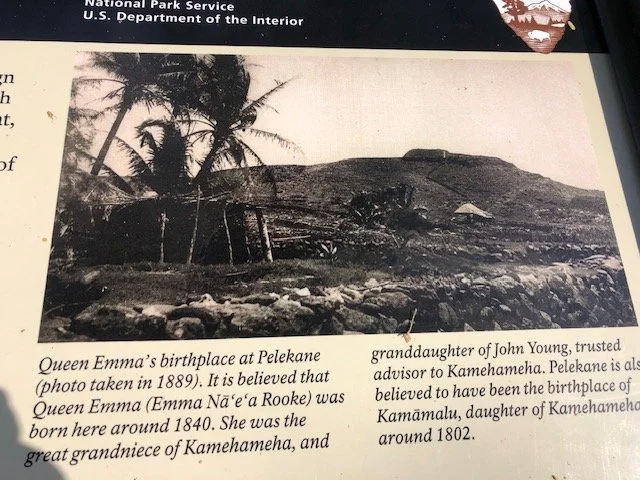
One of several historical knowledge signs along the walking path.
Leaving the beach earlier this morning to achieve ordinary, hectic errands in Kona an hour drive away, brings me to where I sit now in my living room late afternoon. Just on the edge of my awareness still floats my mystery word. Isn’t she right around the corner? Books are resourceful in these endeavors like Hawaiian Soul: Resilience, Restoration, and Justice (2025). One persuasive author, Hinaleimoana Wong-Kalu, declares in the essay “Ka Mana Aupuni Sovereignty and Governance for Native Hawaiians” a cultural word-divide to notice. She “provides a powerful example in discussing how Western LGBTQ+ frameworks have been superimposed on the traditional Hawaiian understanding of mahu (individuals who embody both male and female spirits)…from a kanaka lens [Native Hawaiian] there was nothing wrong with being mahu” (147). From a modern etymology mahu can convey as transgender.
And in precontact Hawaii mahu are respected while the word aikane describes male homosexuality often along hierarchy lines as in consorts for the ali’i, Hawaiian male royalty. But where is the woman in frolic, finance, and fortitude relationally with another woman? An author who published the travel guide Rainbow Hawaii Islands, Matthew Link, concludes that “there were also female aikane (the word often occurs in the Pele goddess stories), but since women were subjugated by and isolated from the men, this only strengthened the ‘guys only’ club of royal aikane relationships that disregarded the women.” Even so, optimistic spirit is what I have and continuing research to discover my original goal perseveres.
In the last eight years living rurally on Hawai’i Island in modern Kohala region, for sure what I have discovered is aina (land) energy. Being alert while outdoors is a central tenet from ancient Hawaii since ancestral spirits (aumakua) gather in the shape of trees, shrubs, animals, winds, and sunshines. Spiritually I connect to this vibration. Conversing aloud with inanimate has grounding experience especially because every time I ask permission of the aina before me, may I walk a specific path, the answer is E komo mai, welcome. I am not kanaka (Native Hawaiian) yet while seeing Hawaii archeology on walks, how jazzily humble I feel. If I lift a fern leaf or shift a rock slightly or look at a tree limb, will I discover my word? For right now the search goes in a diverse direction where one of our best friend’s lives, the life of a dog.
In a chapter titled “The Mate: Union with the Other” Clarissa Pinkola Estes defines that “a healthy psyche tests new elements which apply to it for inclusion; that the psyche has an integrity about it, a screening process.” So has been happening in my psyche for writing this essay while on a word sleuthing. In search for a name for two women together is a conjointly adventure for one woman to name her integrity dualities, her mature individuation. Estes explains that “we name these dual temperaments in ourselves in order to marry—ego to spirit. This naming and marrying is called, in human words, self-love. When it occurs between two individual persons, it is called loving another” (129). Being able to hear how, through an astute listening, to call herself takes instinctive psyche beyond basic ego.
Once on a visit to a science museum in San Francisco, Estes recalls walking into a space with microphones and speakers imitating how a dog hears. Crinkling a bag of potato chips easily occurs for our human ears. For a dog not so. “The world of the dog is filled with constant cataclysmic sound—sound that we, as humans, do not register at all” (131). This astute hearing she compares to instinctive psyche in humans. And challenges anyone willing to listen so sharply to what and how language works in her life as being fiercely focused, a wildly specific willingness to persist. “This mediumistic—as in medial—aspect of the instinctual psyche intuitively hears the deep work, the deep music, the deep mysteries of the feminine psyche. It is this nature that is able to know the wild nature in women” (131). Simple question to ask is what dog whistle—a nonhierarchic language beauty—do you hear that others will not listen for?
In her book Nine Gates, Entering the Mind of Poetry author Jane Hirschfield imagines well that as readers we hear a writer’s voice—formal, argumentative, emotional, linear, textured—like “we gauge a person’s kindness by tone…we intuit these things as a dog intuits another dog’s friendly or challenging disposition” (29). In hearing what qualifies as original voice, or resonating truth for writer and reader alike, is “in the quality of listening that accompanies self-aware speech…those whose ears turn at once inward and outward, both toward their own nature, thought patterns, and rhythms, and toward those of the culture at large” (29). In this way is how I have been listening—my ears diligently and dog-like to the research grounds where I have just been with you, reader, while writing this essay and where I walk daily—to a word that aptly describes one woman’s partnering with another woman.
The word is lesbian and next week’s essay will explain why I choose this word. Catch you then, dear reader. Or any ‘ol damn time she wishes.
Chapter title is from Clarissa Pinkola Estes, Ph.D, author of Women Who Run with the Wolves, Myths and Stories of the Wild Woman Archetype (1995).
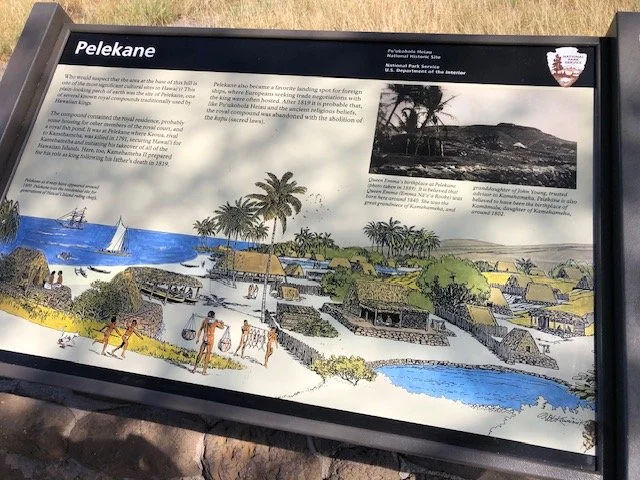
Pelekane social compound based on restrictive kapu system closely adjacent to Pu’Ukohola Heiau.
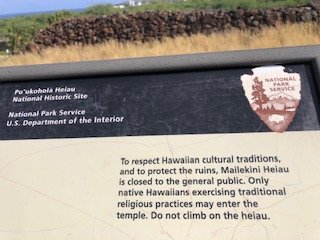
Native Hawaiian sovereignty respected through cultural preservation.