Shark Footprints: How We Humans Revere
A shark’s glide through a cove in ocean shoreline waters, visible watching from a beach, looks strategic in that dorsal fin slicing. A muscular pounce might happen and we peoples revere an animal’s brutish, mighty feeding. Humans can even assume powerful bestows on them grace-like simply for believing in sharks. Shark teeth necklaces have been liturgical for eons.
When we speak quietly to ourselves in our minds, we search for ineffable spirit to join. In these self-talks, we create hope. When ancients built Hale o Kapuni Heiau (peaceful, sacred temple), today a National Historic Site in Hawai’i, to respect sharks, likely what cultivated is hope heard in quiet prayers and communal chants. Native Hawaiians believed aumakua, caring ancestral spirits, returned from across generations to aid their people currently, appearing as a specific shark, for instance. This select shark was revered through prayer and ritual. Whether in the late 1700s described here, or modern today July 31, 2026—how humans revere is to understand how hope works in our lives.
When especially quieted any human hears how to trust proximity. Hope fuels on trusting what is close. A helpful dynamic to explain life’s unknowns—and how few for-certain knowns we have ever known—is revering what is nearby. One time a while ago in my life a humbling mystery called holding a brand-new human, my son Darien, gave me trust to hope I could carry my maternal process through and I felt carried on faith in goodness. I prayed often. Reaching for what was near, I discovered a book because I have readings close to me always. The closeness of them and my reverence in them, I find hope.
When my son Darien arrived to the world on October 21, 2010, from the time when he was one week old to one year old, I read a few pages to him every day from religion historian Karen Armstrong’s book The Great Transformation, the Beginning of Our Religious Traditions (2006). Over the course of hundreds of pages, she demonstrates why humans always search for hope through how we revere—a practice ever since our start on Earth. Through placing our trust and faith in what is local we hope our lives will thrive healthily.
Monotheistic religions like Judaism, Christianity, and Islam evolved over centuries from pantheism and a result is one “God” often sky-high separate from the land. In contrast, indigenous cultures revere spiritual energy imbued in nature’s infinite resources close at hand. Anyone can pay attention in this liturgical space. An idea Armstrong devotes her writing to in Sacred Nature: Restoring Our Ancient Bond with the Natural World (2022).
Nature’s surround-sound, 365-degree walk about seen through close-up reverence gives a chance to see the familiar new. What we have learned over the centuries is that sharks are often not brutish attackers. When faced with peril, they protect. Clearly nature’s examples of violent thriving are prevalent. Television’s reality shows can portray human examples of this, for we are equivalent to any sentient existence in nature. In 2000, I remember sitting cozily before a large television screen in our Noe Valley living room being stunned at the “reality” TV show “Survivor’s” premise: a competitive race to brutishly defeat other humans. Nature’s grace (homeostasis) is simply an aside, a manipulated material to achieve winning. Comfortable San Francisco life I had, and I only lasted one uncomfortable hour watching this show.
Promise made is one I kept to not watch again. And I have often winced while watching “Shark Tank” because the dismissal process can be decorously brutal. Good news is the “shark” investors often show empathy for who to support financially and who not. How this show reveres is to prioritize shark like strategy sensing when to cruise along and when to move in directly or what capitalism calls the “free” market. Yet what we attribute to sharks could just be us acting innately human.
Another way for being human is quieting to simply vibe with complex nature’s immersive details. Being willing to trust an outdoor walk has spiritual merit, hopefully, meaning a leap of faith hence the word sacred. How I revere on these Hawai’i Island lands is a sense of being carried, a tropical energy to trust I will commune with animate forces (often called inanimate) all around: lava rocks, corral, sand, ocean water, trees, sunshine, clouds, blue sky, birds, insects, and more infinitely invisible yet sensed.
The walk from Hale o Kapuni Heiau to Spencer Beach Park takes a few leisurely minutes. Continuing to stroll through the park absorbing energies of people relaxing and valuing the ecosystem: palm trees, mellow ocean waters, evenly raked sand beach, mongoose sprints, and water sprinklers nurturing green lawn is to revere life’s abundance. At a south corner of Spencer Beach Park a walking path begins towards Mau’umae, a popular beach cove for swimming and dogs are allowed on leash.
For years walking this ocean path was under trees creating shade. But after a fire the trees sat for a while charred until land workers removed them. Today the walk happens in direct sun, a few shady reprieves, which often means scorchey sand heat. Even so a few days ago with my dog Bell I was overjoyed to go.
My eye’s retina continually drifted taking in all the ocean water twirling with light—so many variations along the walk. Pungent smells available to notice if willing and I brought willingness to inhale aromas: leaves and sand and trees and ocean edges rising scents into the air after these last few weeks of tropical rain. Vapory salt in the air, soaked and now drying dusty sand-dirt, and humid air feels a physical presence on my skin before a light, warm wind redirects.
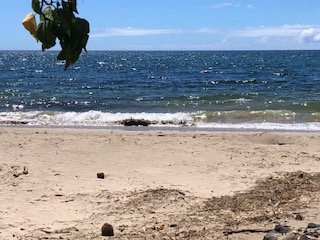
Mau’ Umae Beach Cove
At the beach scorching temperatures encouraged me to rest on a rock in full shade. Proximity to ocean often has me stare, wondering how magnanimous ocean waters are. Wave after wave after wave, she keeps giving. Humbled into quiet respite, for the walk here had been a nature-walk’s exertion briefly in high-heats, Bell and I regathered ourselves. She was breathing furiously and I was drenching in sweat. After ten minutes, seeing her calm I saw my chance. Scooping her into my arms I walked into the ocean. Cool waters she reacted with curiosity rather than upset.
A brief ocean water dunk revitalized motivation for the return hike, now a strategic walk to beat the heat. My impatience kicked in while watching Bell trying to dance over the scorching-sand. Sensitive paws she has, so I picked her up and carried my 35-pound dog for a stretch until even a sliver of shade was ours.

Bell appreciating a day at Mau’ Umae Beach.
An hour ago, when we first began on the Spencer Park side of this path, I observed footprints, paw prints, too. Frequented sojourn place, I concluded. An immensely popular poem “Footprints in the Sand” describes just one set of sand footprints during life travails to imply we humans are carried on spirit’s walking grace and this is how I saw my moment with Bell. I carried her and I was carried through nature’s incredible effortless effort in my lifetime and I saw in history how shark “footprints” probably carried dwellers on this coastal land who perceived a nonhuman source as powerfully hopeful. What reverence is ours for the choosing.
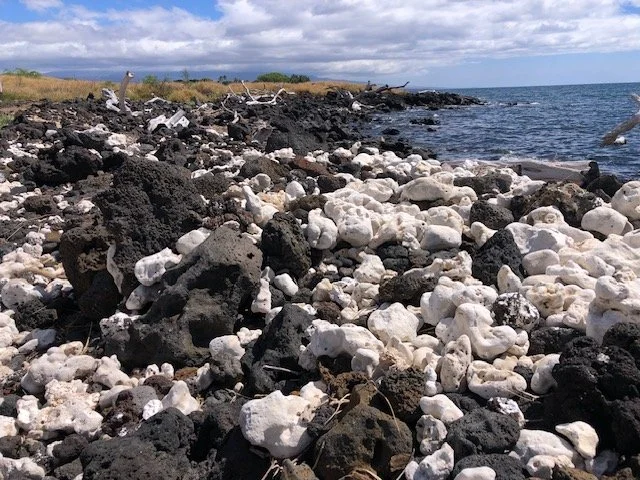
Lava and corral gathering as one on the walk to Mau’ Umae Beach.
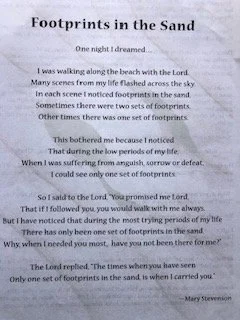
“Footprints in the Sand” poem.