Language Is Her Dance Step
Language is the taproot for identity. A taproot centers all flourishing plant growth. So with my chosen word lesbian, my life growth centers on an original word fitting life flow during a one day at a time living. In the presence of other lesbian women, I often feel like grooving a few dance steps wherever I be.
When the word has absence, I often reach for my ceramic cup model of living. How can I fill up anyway? Culture often has a way of separating a woman from her chosen way to live in the world. Being a woman defines as self-care for finding, tending, and filling her own ceramic cup. From the book Hawaiian Soul—Resilience, Restoration and Justice one essay “Weaving Our Place” has authors Dancil and Kimura. Keiki-Pua S. Dancil, Ph. D. is Senior Vice President of Government Affairs and Strategic Planning at Pulama Lana’i. Ka’iu Kimura is the Executive Director of the ‘Imiloa Astronomy Center of Hawai’i and the Director of Ka Haka ‘Ula O Ke’elikolani College of Hawaiian language at the University of Hawai’i at Hilo.
Each woman recalls times when being asked to fetch a cup of coffee. “Dancil shares experiences of being asked to ‘go get me a coffee’ before giving scientific presentations, describing the shock on colleagues’ faces when they realized she was the scientist scheduled to present” (1999). Filling up a spiritual daily-dance energy has a metaphor of ceramic cup. Paying attention on a literal level, too, vital for deciding her own way.
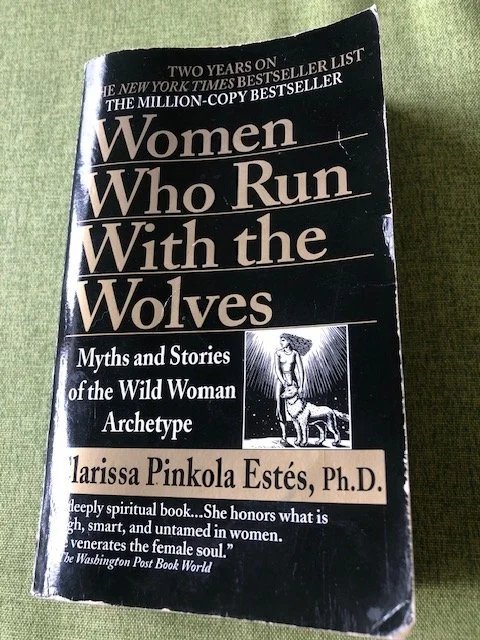
A woman self-empowers through asking two questions of herself and of her partner: one) what do you want? and two) what does your deeper self desire? We hear these questions while reading Clarissa Pinkola Estes book Women Who Run with the Wolves, Myths and Stories of the Wild Woman Archetype (1992). Takes understandable courage to choose not being tame in her day when being wild (not reckless without boundary) renders real living, a real challenge. Yet being open to working with her own duality—tame and wild—she has a chance “to securely weave a relationship, [because] a woman will also ask the same two questions of her mate” (135). Reciprocity like this is how I begin to define a chosen word that applies to my life: lesbian.
I seldom assume because that makes an ass out of you and me. Estes illustrates well the process: “if one takes a woman at face value, one is in for a big surprise, for when the woman’s wildish nature rises from her depths and begins to assert itself, she often has interests, feelings, and ideas which are quite different from those she expressed before…to love a woman, the mate must also love her untamed nature” (135). In being wildly open for my own self-growth, I encourage others especially women who are lesbian close to me. The wildness of learning deeply further who I am one serenity ceramic cup moment at a time continues growing my life from taproot language.
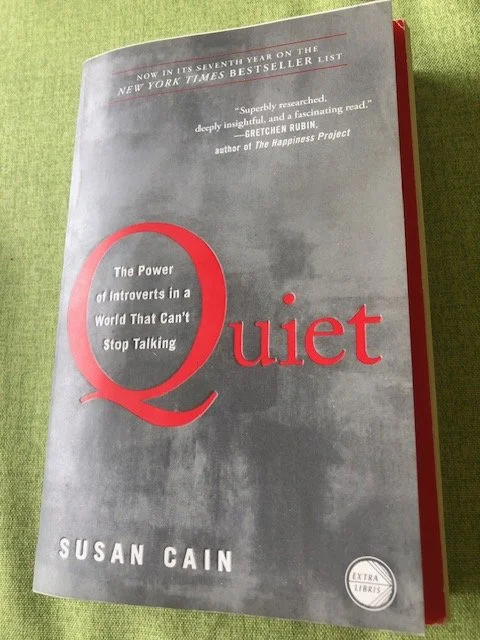
Daily I choose my behavior based on consciously valuing how I act, what I say, and what I create—a chance to discover my wild woman interior lesbian. What I learn from Susan Cain’s book Quiet the Power of Introverts in a World that Can’t Stop Talking (2012) is actively celebrating my chosen living scenario, one that energizes in right ratios. In doing so many women like myself admit we are not shy. “Shyness is the fear of social disapproval or humiliation, while introversion is a preference for environments that are not overstimulating” (12). Being clear on my own energy choices frees others in my life to inhabit her own.
In this conscious lesbian way, I follow through on self-designated responsibility co-creating with others. I can sweep a broom well in my house not for woman gender reasons simply because is a fair share. And I can share public-facing creative work not for gender reasons but simply because a gift to go there has been given my life. In each scenario quietly respecting all is my energy.
But since the early 1900s American culture turned hyper aware towards venerating an Extrovert Ideal, “the omnipresent belief that the ideal self is gregarious, alpha, and comfortable in the spotlight” (Cain 4). The change happened when populations redesigned from having a circle around you, them knowing you and you knowing them, for quite a while. A wider crew of family. A gathering of people in a locality close to your house. Cultural groups based on interests central to living—often rural and farm-centered—requiring a reciprocity to give and to take balanced.
These living modes eroded when moving to cities and urban business work. Not knowing who was standing next to you meant you were in the spotlight to make a personality impression—rather than being already known locally, integrity-wise. In this modern changeover, being able to say to the woman standing next to you, “I identify as lesbian” ensures history’s way of creatively building modern friendships and relationships, a language taproot for future life growth.
When writing last week’s essay, I learned that the word lesbian does not exist in Hawaiian. Observing this language truth is not a critique. Is more like noticing where an absence influences my dance steps in any day. Personal narrative essays like this one claim creative guidance in the prose. The quote I selected from Estes writing is one I must consciously refilter through my awareness. Hers still being one of my all-time favorite books, the word lesbian is not once written in 584 pages. Same is true in Cain’s amazing writing throughout 352 pages. Not once. This discovery process is as much mine as how I imagine for a reader.
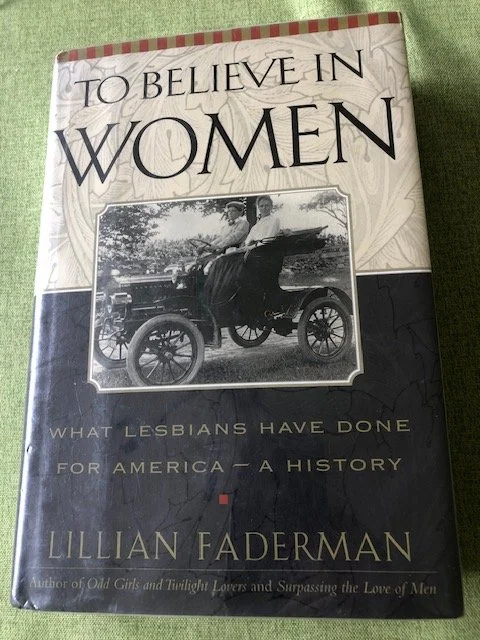
And is a reason why I threw my hands in the air celebrating a few hoorah-hoorah quietly energetic moments with a book. In Lillian Faderman’s work To Believe in Women, What Lesbians Have Done for America—A History (1999) she stakes her radical claim early in the Introduction. “If enough material that reveals what people do and say is available, we can surely make apt observations about their behavior. That is what I have attempted to do in this book. I use the term ‘lesbian’ as an adjective that describes intense woman-to-woman relating and commitment” (3). She gifts 434 pages to demonstrate how lesbian couples’ equality at home work-wise made living-energy motivation for each woman to change American history through social-justice activism.
In a 2026 politically seasonal time in which critical voting (redundant?) happens across America what I find inspiring is to learn how many female couples worked tirelessly so that as a woman I can vote today, at all. Susan B. Anthony and Anna Dickinson are one example of many Faderman describes respectfully through her innovative historical research. Reading the chapter, “The Loves and Living Arrangements of Nineteenth-Century Suffrage Leaders” (15) makes me feel like my dance card is full while owning inspiring language.
Using a fashionable word called postmodern, academics claim in an unstable world no one grand history narrative and no one word could be stable enough to claim as authentic. Faderman concedes to postmodernist lesbian scholars that “a search for a single ‘lesbian authentic identity’ is surely an exercise in absurdity” (346). But she reminds what is at stake. To not allow any striving to historicize woman-to-woman relationships is a detrimentally life-changing absence. “Generations of women who identified themselves as lesbians were never dignified with any history whatsoever, because it was virtually impossible to record it” (346). For this reason alone, language is a tap dance, a taproot to being proud seeing lesbians thrive in history and how these women made history happen. Faderman concludes that “history can provide something vital to any people who bond in a meaningful group” (347). Welcome to the dance floor.