Belonging
A sea turtle swimming in fresh water to reach salty ocean took her time. Her shell has layered-levels, a soft yellow tint showing across and in between precise geometry tiles is algae green and streaks of black. On her face are four exact squares, tiling pale yellow, seaweed green, and beige brown. Even standing thirty feet distant I still just want to hug her because a random turtle sighting makes me feel like I belong while on a lonely walk. How I found this beauty was observing.
Why on the side of a road called Queen Ka’ahumanu Highway (Route 19), a main throughfare taking those starting north on Hawaii Island to a south leeward side (West Hawai’i), are a few cars mysteriously parking at a lava entrance? Living recently ten years on island I never knew this area. While commuting back and forth, I am a carrier pigeon with a scrolled message: what is alive and well beyond in an unexplored coastline? Each driving day I observe.
Anyone can begin this north-to-south driving gig from my address here in Kapa’au and commute to Kona, 65 miles one way takes briefly over an hour. On the way, right-side is mystery entrance. And when I return from Kona going back to Kapa’au, I see a few cars still parked there near dusk hour, now being on left side for reverse commute. Where might I belong in my curiosity? Am I included to go to this unknown location? Cultivating a sense of belonging takes real work in my life these days.
On Hawai’i Island who can go where is quite directive—public and private strictly delineated. Simply that where I am belonging best is in my wandering heart as an intrepid explorer. Balancing risk since I like to know where a nearby convenience store is for water and chocolate if dire begins. Risky enough inviting a grouchy teenager who lives in the house, my son Darien, yet we went in search of mystery on a Sunday a few days ago anyway.
After parking our family car where a few other automobiles already are, the hike begins. I see a few formal posts, clue enough the vista has public rights. Within a minute walking on crumbly lava rock, an established directional path confirms my intuition while not knowing where I am going. Comfortably seeing a curated nature space is where my trust is now and was even when inside mystery-guessing while whizzing past on many commute drives. Learning I have been how Hawai’i Island has diverse, backroad walking paths everywhere. Challenge is to discern on which ones I belong.
This sauntering immerses us in lava swirls to left and right while the main road Route 19 is far behind. Kiawe trees are growing in black lava having found soil determinedly. Several hundred feet up ahead a pack of feral goats are milling across the walking path. I call to them in a sing-song voice, reassurance I bring peaceful. Ambling along they go returning to lava rock and kiawe trees. After walking ten minutes, a black sand beach is where I stand holding my eyes grounded until I venture a look up, staring at the ocean expanse. Anyone’s conjecture what goes there across infinite rippling waves. Staying true along the coastline beach walk (private property signs advise so), I wander for a few minutes walking parallel to gentle ocean low-tide waves. Until I see the beauty turtle.
Belonging is what I feel when I see her. Like with all these coconut trees swaying in warm tropical breeze. The delicious ones are strewn on sand. And I leave them because Private Property signs are also strewn. And likely I would leave anyway since taking from indigenous land is not a path I walk. Like when I enjoy and leave in place those sparkly dancing sunlight-glimmers in ocean water when I scan an endless horizon. Like when I turn around for changing my perspective to face a fresh water lagoon built on a horizontal stretch parallel to the ocean. History tells me this was built purposefully as is the rock walled chute the turtle swims in.
She had been resting in a fresh water lagoon for respite and food variety before returning her way along a two-hundred-foot canal connecting the two waters. Two four-foot walls built on top beach sand encase a ten-foot depth creating a lively channel path for ocean fish to arrive to the lagoon and grow healthier, fatter in the fresh water major pond. Gone fishing Native Hawaiian innovation style. All these impressions I leave behind when I go from observing, yet being there I feel so included like on any return I am belonging always. Nature never excludes anyone wishing to belong.
Being comfortably fit in my lesbian skin wherever I go, I belong anywhere, anytime and just taking extra work recently. Like exploring language’s presence and absence. For example, when I trundled an incline at Pu’Ukohola Heiau after paying homage to an under seawater sacred temple built for sharks (remember?), going into air conditioning was a next goal. Like sourcing a convenience store, I go with resources what are.
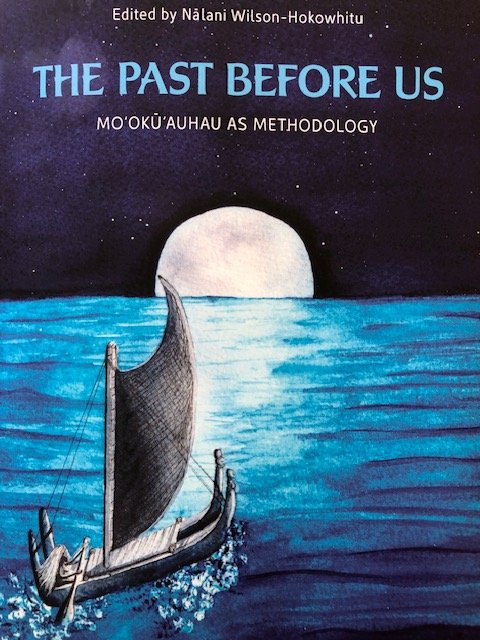
In the National Park history store I spied a book The Past Before Us, Mo’oku’auhau as Methodology (2019). The cover shows goddess Hina paddling a canoe-boat on ocean waters brightly shining under a full moon. Perusing a few essays, one word appears continually and the word is genealogy. This new word is like the immersive nature experience discovering a beauty sea turtle at an ancient fish farm, being called Kiholo State Park Reserve the signs taught me, a surprise knowledge after ten years driving along Queen Ka’auhumana Highway not knowing. So, I qualify the word genealogy as mystery vocabulary to learn and discern if I belong. Is my curiosity welcome in this etymology?
Vibrationally looking likely I belong. For a good many years now I’ve been walking along Hawai’i Island coastline chattering away with rocks, pebbles, leaves, trees, grasses, and waters. Simply because the locale vibes this way. I’m listening to how inanimate speaks trusting how nature knows a living design that I see, hear, and smell. These walking experiences feel like my genealogy or relationship to historical past right before my modern eyes.
Providing an Intro for The Past Before Us, Marie Alohalani Brown, a professor specializing in Hawaiian and Polynesian religions, writes “in its narrowest sense, mo’oku’auhau, often translated as genealogy, refers to biological continuity and biological relationality. Significantly, Oiwi [Hawaiians] perceive the world genealogically. We are part of a complex web of relationality in which everything in our native island world (land, seas, and sky, and all therein) are kin. This relationality is also spiritual for we are the younger human relatives of the other-than-human entities in our island worlds, many of whom we consider akua (deities)” (VII). Making sense now why I been yapping away so happily often when immersed in Big Island nature.
Also, what needs clarity is that I am a haole (foreign born) Caucasian lesbian-woman who happens to have vibes for nature. The “we” in Brown’s quote does not include me because I am not kanaka maoli (native Hawaiian) yet I have a sense of inclusivity based on sensory-energy when I start observing, staying aware, and showing respect during nature discoveries on island. And is why I write this essay to explore how I discover a sense of belonging in the world while outdoors.
An optimal tool to stay in curiosity on where I am going—towards or away from belonging is saying my three favorite words: I don’t know. Alright, technically we have four given a contraction. And much of life is technical. For instance, a few weeks ago or several essays before, however is you wish to measure time, when I began writing “Shark Footprints: How Humans Revere,” I sat on a Spencer Beach Park bench clicking away at keys on my laptop. The ocean’s edge was fifty feet away. What I didn’t precisely know was its name and which direction on a global map I was pointing my eyes.
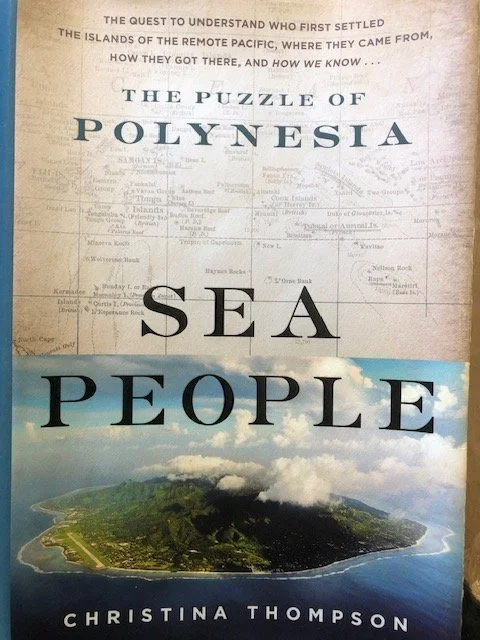
Splashing ocean water at Spencer’s while on a swim is entirely an oceanic sensory experience of belonging. For these few feet where I idly float supportively relaxed in ocean water’s buoyancy, I am at home. This ocean is called the Pacific Ocean and has a north to south distance of 10,000 miles. Going across from east to west takes 12,000 miles and a bit more. Drawing a map, you could pen in this space every earth landmass plus space for another continent size of North and South America together. We know from Christina Thompson’s book Sea People, The Puzzle of Polynesia (2019) that the Pacific Ocean “is not simply the largest body of water on the planet—it is the largest single feature” (18).
At the center of the Pacific Ocean is a triangle that has a northern corner of Hawai’i and a south eastern corner of Easter Island and further south west is New Zealand. These three triangle corners mark an incredible stretch of Pacific Ocean we call Polynesia. My brain synapses had not known this vital information even one week ago—and now I do. Whenever I learn more, I belong further. And learning deeply shows me clearly when others are excluded—language being a tool to go there.
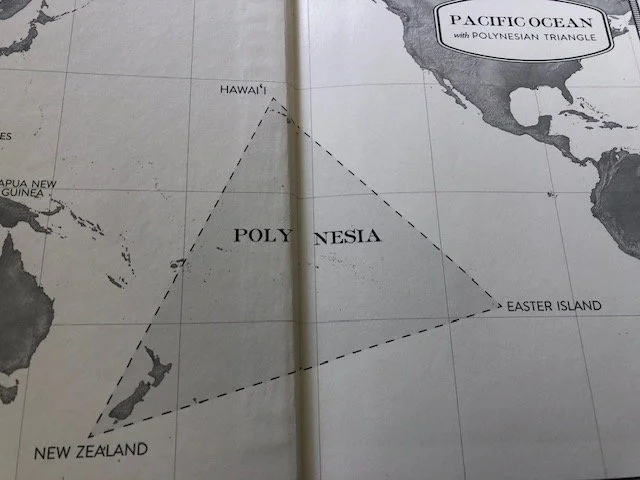
Map shown in Christina Thompson’s book Sea People the Puzzle of Polynesia.
Where I get especially energetically cranky is on behalf of knowledge inequity, meaning how language can abandon truth. Accounts for why I continually search for where the word lesbian exists. Intentional omission is abandoning truth creating a sense of not belonging. How can you belong if a word describing you is invisible? Another example where I could be heard audibly cursing from a comfy living room chair while reading an essay is the name Easter Island.
In a New Yorker essay Margot Talbot book reviews Island at the Edge of the World: The Forgotten History of Easter Island (2025) by British archeologist Mike Pitts. Talbot defines that “a Dutch captain who landed there on, yes, Easter gave it the name many Westerners still know it by. Rapa Nui is the Polynesian name for the island” (Feb. 2, 2026). What I cannot fathom is how challenging is effort to simply write and say Rapanui.
Talbot clarifies that “Pitts follows the convention of using ‘Rapanui’ for its Indigenous inhabitants.” What in the sweet tarnation can this mean? Only folks having Indigenous genealogy to Rapanui wish to have a truthful name applied? In a world of major stresses this one appears minor and yet, really? Where else but truthful words can we begin? In the New Yorker’s Table of Contents only Easter Island is listed as the essay’s topic. Might not be astronomical in cost to typeset Rapanui (Easter Island).
And explains why I’ll be adventuring into a specific book on a search for Hawaiian historical context for our word lesbian. This week I’m reading The Mahele of Our Bodies: Na Mo’olelo Kupuna Mahu/LGBTQ, a curiosity expedition on language and identity sensing, how to feel like a place in the world is reserved language-wise for you. Each of us belonging in our own way. Curiosity can be contagious so my guess is all those prior blog essays that still need perusing are top priority for readers. Alas, a writer keeps writing and a reader reads any ol’ (yes, I moved the apostrophe, finally) damn time she wishes. A hui hou.
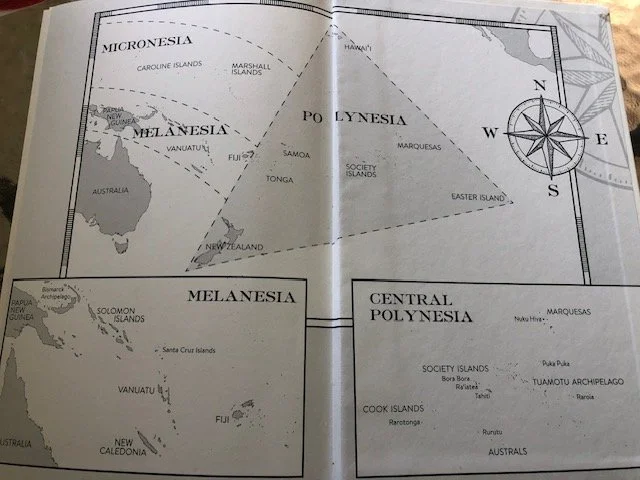
A map from Thompson’s book Sea People.