Travel Dispatch Six~~~What Desert Flower Helps a Tribe Bloom?
Twas the season for people pleasing. All the festivity, over-portioned meals, endless platters of glittery desserts, gifts waiting with receipts to be returned and cantankerous often disorderly family milling around in dysfunction. Sober occasionally. How many movies portray the annual emotional fiasco called Thanksgiving and Christmas table settings? Then again how might a sweetly not hellish winter solstice be looking like on the December calendar?
A brief latte with a close friend and seeing that family disaster movie rather than being in it is my existential path or conscious choice in the overwhelm. Maybe even a wild splurge and purchase popcorn? Why not call this an achievement like auntie knitting seasonal mittens: one movie, one popcorn, one mitten, two mittens or getting a grip on Christmas busy? A winter, seasonal film and popcorn will cost you $30 out the door. Simplicity like this means narrowing your essentials and everyone in your tribe has the right especially as we age.
While reflecting on 2025, we can ask why not? Many are already going in this direction since mas christ is not on the spiritual path for Hannukah and Kwanzaa. (Even so, Jésus, da braddah from another madre, and I are all good.) Millions of Muslims worldwide are skipping the shopping debacle for Christmas. If the day or the season of Christmas is for Christian generosity then share the love year- round is an altruistic suggestion. Since what gathers a tribe is the free gift, a felt-sense called belonging and not consumerism, anyway.
The decided connections are those prayerful cultural elements—movies, musics, books, culinaries, and ugly sweaters—that bring platonic friends, romantic friends, work colleagues and diverse others who feel good in their tribe sitting cozily at a winter neutral table bonanza. And decide to spend the hustling holidays at an earned seat at this social meet and greet, but lightly so.
Enacting closure on year 2025 brings reflection: just how specific did my people-pleasing detrimentally be to being peaceful wherever I went, year-round? Was I hearing my needs and wants, the art of listening closely to who I womanly am in the world, taking effort and clarity and not people-pleasing? Looking back, I saw one year-long strategy as owning a decisive soulfulness, inclusive in my lesbian clan and also divergently on my own path. Even the majestic red velvety rose has thorns to draw blood. So, with setting boundaries. Beautiful life bloom can be difficult.
Irony followed me when I walked out on a room full of women ensuring a harmonious life path rather than a disputatious one. And just this morning I ended a Zoom meeting when the timing was so obvious. Not for always. For the seasonal health of my self-care holiday momentum. I belong and I am an insider on the inside of my lesbian clan, yet stepping away to look back in reflection is always progressive to eliminate people-pleasing. Gives a chance for ongoing learning deeply who I am. And now my clan continues to know me better, too. Boundary setting and judicious timing takes the best work of, from, and for each of us in our tribes.
The year 2025 is a celebration to wave people-pleasing goodbye right here, right now, which portents self-growth 24/7, 365 in my future days. Now there’s a New Year’s confetti throw. Perennial challenge is that the work has often brought a lonely high road. Notice I did not write martyrdom, which is a hallmark of codependence: meaning I over rely on your reaction to feel worthy. Now women are often in a state of six degrees of separation from people-pleasing—this did not happen because so and so did not show up and that upset so and so when the family needs a meal on the table, grocery shopping yet who is the so and so to handle the mess? She just walked in the door.
Hello, people-pleasing and a familiar holiday woman’s role is to mediate holiday stress, cook food, and keep family dysfunction flowing micro-managey style—aptly describing many families. No is a complete sentence. No, thank you for this scenario. I would rather stay in empowering simplicity, a holiday welcome for all moments being brand new and gratefully so. Don’t forget the popcorn when you catch a movie, closing the door carefully on the mess upon exit.
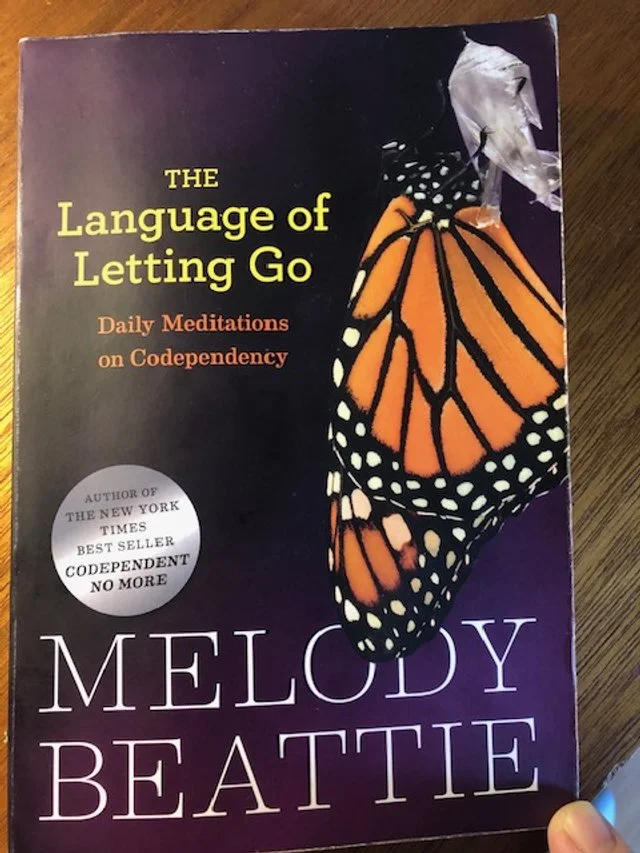
Today I have the lonely power to leave the familiar. Mind you, stays important how Melody Beattie in her book The Language of Letting Go describes people-pleasing through an empathy lens. “Taking other people’s wants and needs into consideration is an important part of our relationships. We have responsibilities to friends and family and employers. We have a strong inner responsibility to be loving and caring. But, people-pleasing backfires.” That’s why many call that bird a phoenix because ashes burnt her aviary potential to a crisp, and, yet look just there at the field’s edge is now a dexterous bird gracefully riding the goodness-infused air any ‘ol damn way she pleases.
True, a sense of aloneness when I strike out on my own is not being alone since spiritual goodness is always floating around in the air that we all breathe. And I don’t lose any of the growth that happened in a prior social circle. Continual change—integrating yesterday and inventing today—is happening when I stay open. Which means the second way to end people-pleasing—other than owning the realistic option to say no—is discerning when the time is right to effect newness. Takes courage and I likely will be wobbly at the process for a brief while, probably the rest of my life. The key is willingness.
Mind you the process to start anew in an aspect of life is consistently awkward, usually difficult and what I know as lesbian true is family unfolds where equality is clear amongst the women. Troubling is that in 2025 we have had times when I was being techie controlled. And this simply won’t do so I went seeking power elsewhere and is the reason why this essay focuses on travels. Vital to leave your own tribe to send a message. Listen up, people: this newness called saying no is a word I apply to unclear, indirect messaging. No, thank you. Simplicity. Expand my horizons and join a new group, I thought.
Which is why I found myself being a Zoomer online to accelerate swift changes. While never in a hurry, I am also impatient. Besides, this sobriety clan was calling themselves Women Who Run with the Wolves. Decades before I had the book on my desk and simply had never devoted the time. Several months after attending and participating, what I discovered was a talking den where we she-wolves could wax poetically any 'ol damn way we wished. A powerful conversational space, lesbian infused and all.
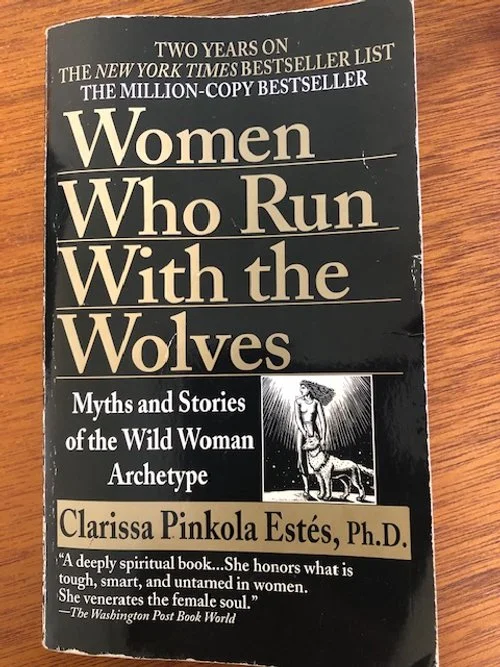
After a few weeks, I sat in my living room cushiony chair and began to read Clarissa Pinkola Estes’ original work Women Who Run with the Wolves, Myths and Stories of the Wild Woman Archetype. Published in 1992, I was curious how modernly apt her insights might be. Once I read the 22-page introduction, the air had electrical sizzle. Literature has an aim to shift lives, changing them to amplify courage and challenge passivity—yours and mine. That is how I felt after reading the Wolves intro. The book is an entire treatise on ending your six degrees of people-pleasing: socialization, culture, stereotypes, institutions, and families that place limits while asking a woman her life question—who are you?
Clearly seeing I was throughout 2025 on how to set boundary, deciding who I am amongst other women. Velvet rose petals and direct thorns discovered. Courage showed up when I would leave entirely for becoming further whole on return. If I decided on that. When I left, where I went was essential for a commitment in nature. Nature is a best tutorial on belonging in my decided tribe—especially the moon. One place where a woman can hear herself definingly well is in the desert under a full moon.
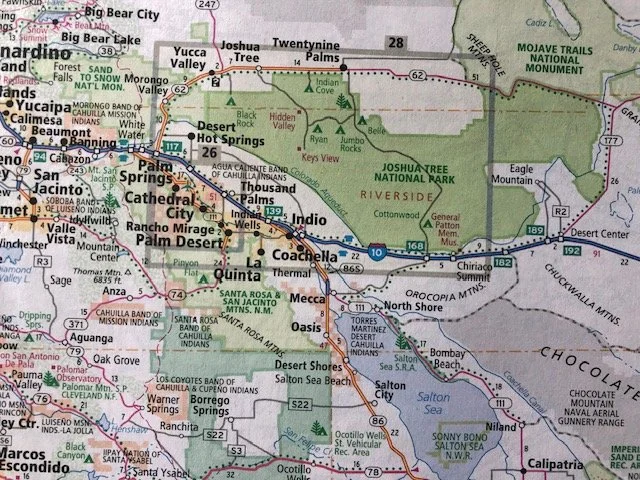
At my desk in Kapaau, Hawaii I saw a full moon calendared for June 11, 2025. The reservation scheduled while at my desk made possible several months later camping at Joshua Tree National Park this evening. After the day’s sweltering dry-heat 90 degrees, what begins to appear in the night sky is one after the other twinkly bright stars popping through dusk skies: striated colors of light and dark blues and grays, a tinge of feint sunset orange horizon hovering.
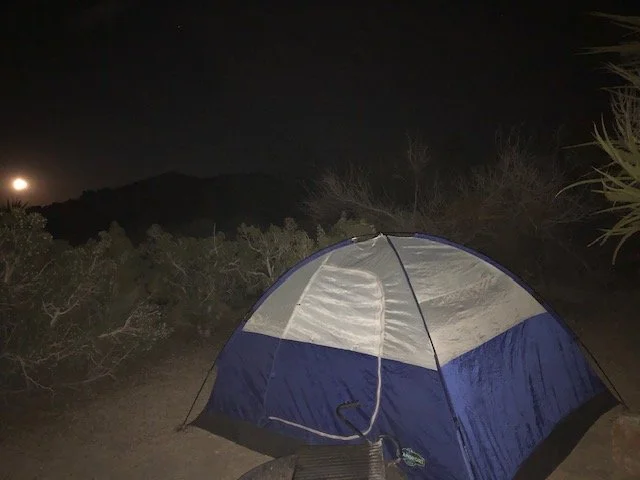
Until one gigantic shimmering, luminescent dusty-reddish orange globe starts to float upward. A June full moon. Astounding in a quiet way was seeing desert so barren yet rippling with energy. Shrubs, sands, rock formations, and all else are reflecting this light, simply at night because the time is nearing 9 p.m. After an hour of watching, I go inside my tent where I continue sitting comfortably, the widely desolate and complexly full desert outside, and I am staring at the full moon through an open-viewing roof; nighttime warm wind breezes all around, breathes of life.
I had the willingness to be here in the desert, no expectations for me from others or from me for others, which keeps me lightly open. What might I learn in the desert so wonderfully alive if looking past the obvious? A gently swaying lantern keeps my tent lit up while I read Estes inspiring prose during this nighttime.
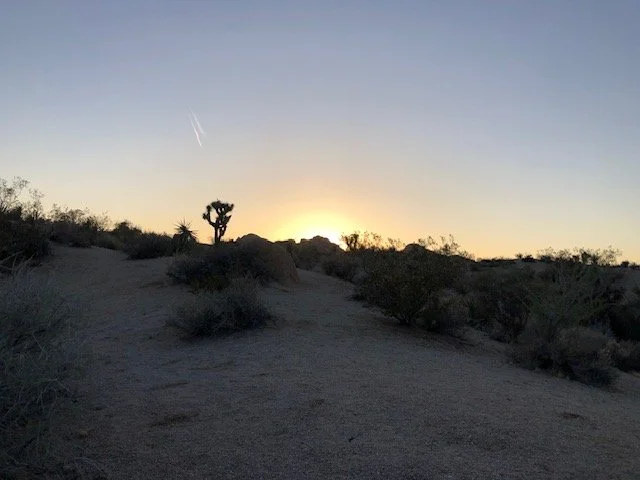
Joshua Tree National Park sun setting around 7 p.m.
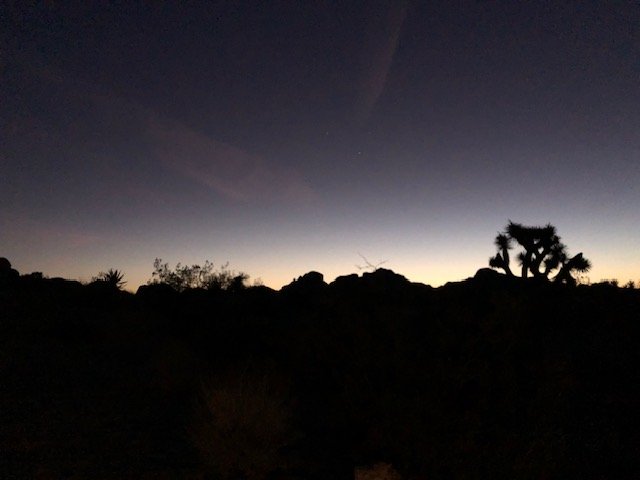
Joshua Tree National Park dusk happening around 8 p.m.
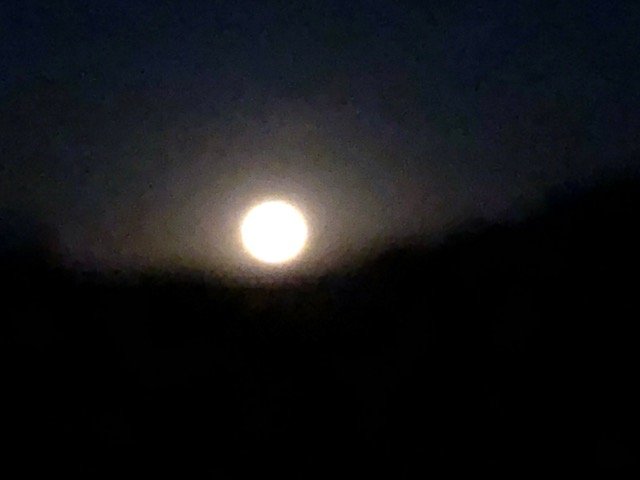
June moon appearing on the desert horizon around 9 p.m.
In an early section “The Howl: Resurrection of the Wild Woman,” she emphasizes how bones are literal meaning for indestructible, fiery substance. Literal in our bodies and symbolic in our spirit-souls. Each and every one of us has a soul that continues despite life’s strife, especially a woman’s. “We all begin as a bundle of bones lost somewhere in a desert, a dismantled skeleton that lies under the sand. It is our work to recover the parts. It is a painstaking process best done when the shadows are just right, for it takes much looking...” This incredibly moon-bright night had shadows that are luminosity kind, revealing serenity goodness rather than covering distraught searching. Peaceful vibes lighting the way for my psyche.
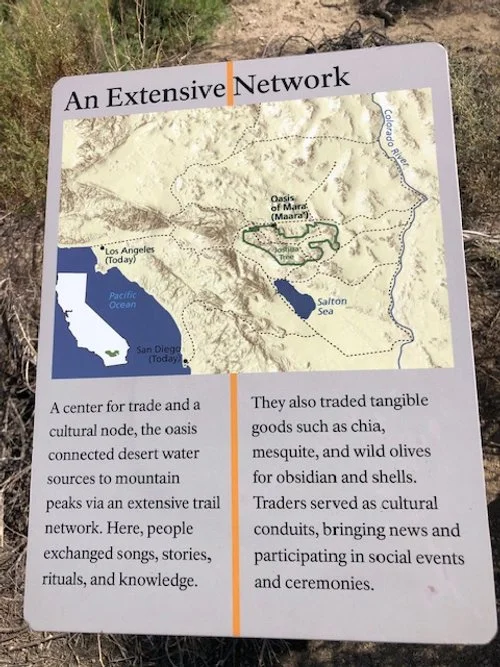
Curiosity is how I saw the desert that was inert on a surface glance and, once again, when I stood still at one of many history and landscape park roadside signs, I felt an energy beneath my sneakers that was strong. Maybe like when standing on a train track and the quay rumbles slightly when the train arrives. This quiet shaking, a feint tremor of history, heat, sand, rock, and beauty were traveling on tracks beneath my ordinary sneakers. Grateful I was. And Estes describes the travel time I had there.
A bright moonlit time to simply be with myself. “This is done by descending into the deepest mood of great love and feeling, till one's desire for relationship with the wildish Self overflows, then to speak one's soul from that frame of mind. That is singing over the bones…this womens' labor of finding and singing the creation hymn is a solitary work, a work carried out in the desert of the psyche” (27). In that moment I saw clearly how a desert is never arid or absent or fragmented and parallel I could feel how at times in my life I felt this way about my lesbian self. Was a healing to be with the desert when she taught me so well to let the past go. Self-awareness in this precise time felt so much like a desert flower, the random intensity of color and purpose, a knowledge that has been with me my whole life and grew deeper still that moonlit night.
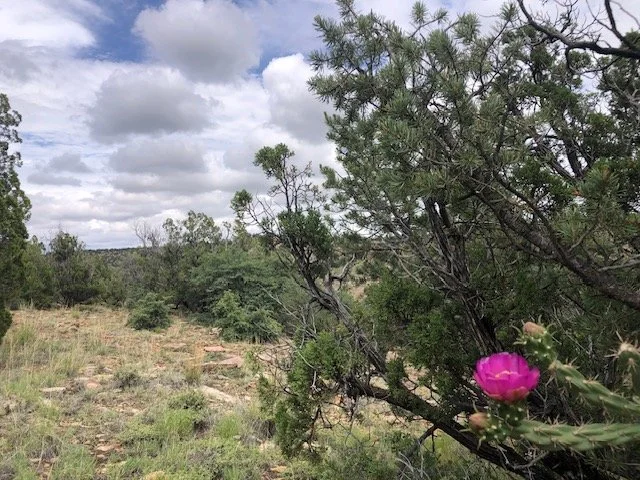
A cactus flower in bloom at Villanueva, where rural mountain and desert ecosystems thrive.
The moon is like a glass globe brightly lit from inside this June 11 evening. I tried to sleep and yet the hours mostly kept me in a liminal half alert, sleepy state, moonlight shining against my eyelids. A healthy adventure for self-discovery is the gist of travel. Not all is chosen newness while traveling because the familiar does accompany you. Like moon cycles being true the world over. And what also remains consistent is how travel lasts as timeless impressions. A visual memory is a treasure trove that is free to entertain your one swift life like a cactus flower, a sequence of brilliant colors for no other reason than aesthetic immersion—brief and yet lasting. Writing these words six months later I can still feel like I am sitting in that tent and walking those desert sands now.
My recollections stayed with me all during fall season and into a Thanksgiving Day at Kahalu’u beach—ocean sands these and not of the desert. Empathy I kept while watching my busyness during early winter season. Had I left my discovery desert to learn more self-insights? “Some women don’t want to be in the psychic desert. They hate the frailty, the spareness of it,” is the way Estes kindly describes a challenging process. Yet American holiday busyness is like a desert, looking devoid of substance since the surprises are not so readily obvious. A chance happened for me on Thanksgiving Day 2025, several weeks ago, to have courage.
Lonely is what I felt when returning from a social gathering on a Hawai’i beach where really good people had prepared a feast. Was a familiar psychic desert where I needed to welcome the frailty, the spareness of not knowing how the moment had richness, emotionally so. Slowing into my feeling alone moment, I heard a motivation to reach for Gloria Anzaldua’s book Borderlands / La Frontera. And one random flip into the book brought me the section titled Cihuatlyotl / Woman Alone and the poem Holy Relic. In this poem Anzaldua describes St. Teresa de Avila’s bones being carried away, literally a tomb raid via five patriarchal priestly moments, after which a patroness of writing was returned—what was left of her skeleton—to her original burial site.
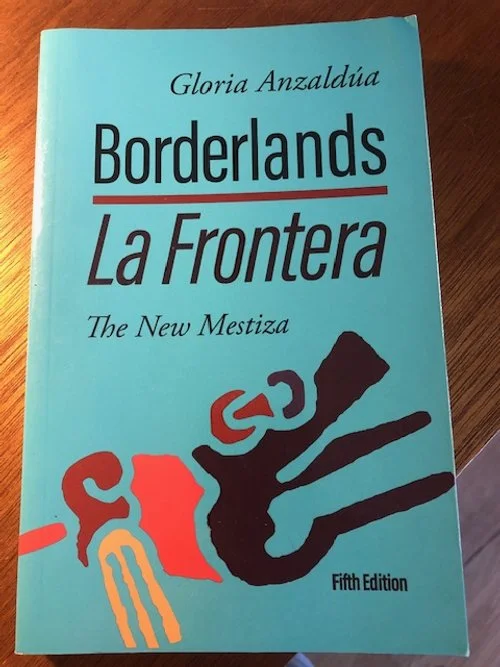
What spoke to me on my lonely Thanksgiving evening was Anzaldua’s dedication of the poem to Judy Grahn and V. Sackville West. Each woman in her historical era sourced her psychic desert to bring powerful prose, often lesbian centered, to the public—the familiar dynamic how literature is expansive for all lives. The refrain Anzaldua begins and ends the poem with, plus repeating several times throughout, goes like this:
We are the holy relic,
the scattered bones of a saint,
the best loved bones of Spain.
We seek each other.
Now poetry is open for diverse readings and mine is Anzaldua’s claiming her place in the writer’s tribe, a simple, sacred work, loved by many on occasion (and often not), and that writers like Grahn and Anzaldua, and aspiring writer Garrett, are in a writing tribe, woman focused and lesbian centered. That lonely evening the spontaneity of finding this poem gave me solace. And I was grateful for having learned how to dwell in the psychic deserts of any given day. Those in all tribes, “we seek each other.” Women writers are often in a shared collective unconscious writing den so that Estes refers to bones in her work and so does Anzaldua.
Anzaldua writes from a Chicana, a lesbian, an activist, and a writer’s perspective about the U.S.-Mexican border that she describes as una herida abierta, an open wound, which is “to form a third country—a border culture,” often in desert locations. In her poem “Holy Relic” she gives tribute to the bones of St. Teresa de Avila given her spiritual lineage as a patron saint of writers. Anzaldua’s poem pays homage to bones, the historical feminine divine that Estes also identifies as having a long lineage. “A woman need not live as though she were born in 1000 B.C. The old knowing is universal knowing, eternal and immortal learning, which will be as relevant five thousand years from now as it is today, and as it was five thousand years ago” (Wolves 473).
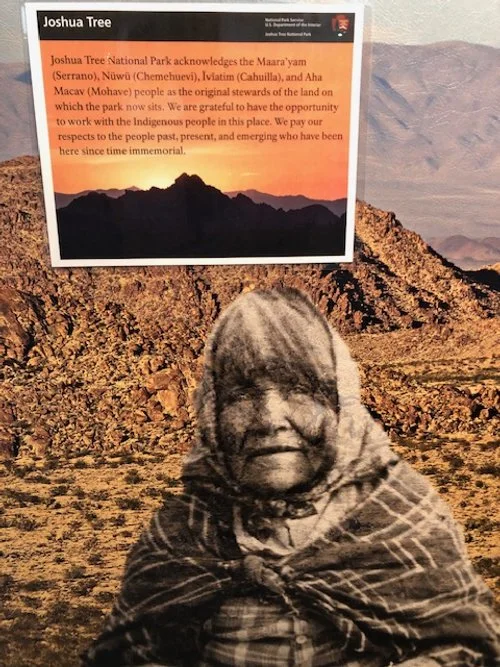
Estes names this intuition as La Que Sabe, She Who Knows. Walking on a lonely desert road she might be. And I saw more than a few women doing so on my travels through the Mojave Desert. At my holiday desert desk on Thanksgiving later evening, my intuition brought me to Anzaldua’s poem. A la que sabe filter so often goes with me on my travels, too. Arriving to Joshua Tree National Park gave an ambience of ancient wisdom right away. A deeply quiet and still energy suffused in heat temperatures. Felt like an outdoor heritage standing there staring at all the Yucca trees. The name Joshua tree is Christian based and Yucca is a plant name from time immemorial relied on by Native Peoples for diverse usage: threads for weaving, braided soles for shoes, clothing structures, and more.
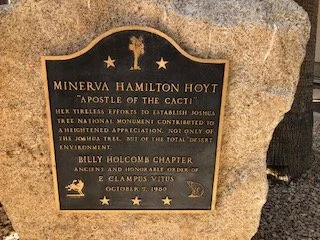
And at the Joshua Tree National Park station I smiled softly when learning that Minerva Hoyt was a Los Angeles socialite woman who reversed and halted the desert carnage happening in this area; thousands of cacti were being lifted for decorative usage in Los Angeles homes. In 1936 she succeeded persuasively enough so that President Roosevelt declared the desert environs a National Monument (eventually designated a National Park in 1994).
A few days ago, the year 2025 closed. Each of these new year days forward, my womanly tribe of La Que Sabe I participate in even more actively so. Yet walking away from any tribe where equality is not obvious is an option. Connecting to other writers in a creative tribe, especially lesbian authors, continues all during the year. We seek each other. People-pleasing ended last year since I am willing to live in simplicity, walk away if necessary, and continue exploring nature environments as a chance to witness powers there, the psychic desert that is abundant in self-knowledge.
Being yourself is simple but not easy. Beattie reminds us why to go there. “The most comfortable people to be around are those who are considerate of others but ultimately please themselves. Help me, Goddess, work through my fears and begin to please myself.” A working program for life, then.
Estes describes the process so fantastically well. “A desert is a place where life is very condensed. The roots of living things hold on to that last tear of water and the flower hoards its moisture by only appearing in early morning and late afternoon…don’t be a fool. Go back and stand under that one red flower and walk straight ahead for that last hard mile. Go up and knock on the old weathered door. Climb up to the cave. Crawl through the window of a dream. Sift the desert and see what you find. It is the only work we have to do.”