Pick a Card, Any Card
When an image filters into my awareness and a sound is an accomplice, soon my curiosity goes there. I wish to follow what has drifted on a haphazard intention to be in my neuron receptivity. For example, if a few cards from a playing deck are taped adhesively to bike spokes on a bicycle wheel, I can hear them. In the flapping sound, I can measure going forward. Picture I can a wheel in momentum rolling at necessary speed.
During a challenge day I often ask myself if I can hear a few flapping cards—life has given me a full deck, thankfully—and how will I play them in this exact moment so the wheel carries me future forward being on a bicycle tire’s roll noisily carded? How will I play a gambling hand my life has been dealt? Pick a card, any card are infinite options a privileged life offers in a deck of choices.
One summer time a few years ago I stared at 100 plus miles of travel. The road was heat infused and I saw a few oily mirage puddles further along. Desert vastness all around gave me a sense then, and a recalled feeling now, to act like a cactus—keep spiney sharp my outside while drinking plenty water to hydrate inside.
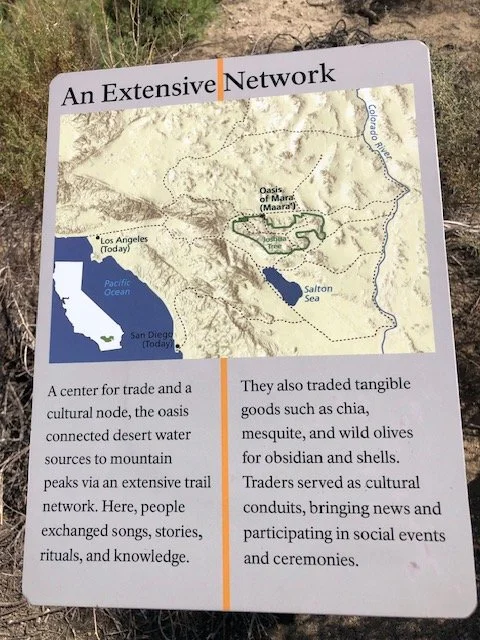
I was just leaving Joshua Tree National Park desert environs, including a Mara Oasis where Native Peoples the Serrano and later Chemehuevi commingled lives lived on healthy food grown irrigated with fresh spring water, dwelling here resourcefully for years. Today the national park works to show respect for 15 traditional tribal communities who are our original land stewards at the oasis.
Leaving the car for a minute on a sand dune to the side, I had stepped into the middle of the road. I stared at this narrow two-direction road going directly forward a 100-miles and further. That yellow center-ribbon where my sneaker toe kept a drum beat tapping is like the wind took a spool of ribbon, tossed carelessly into the air but landing precisely even in the center, a graceful unraveling as far as I stare into distances. Desert as far as my eyes were seeing everywhere surrounding. Nobody way out here. I heard a feint wind rustling and dry sand crackling, trying to get comfortable in the intensive heat. Ignoring the road’s heat mirages, I drove on.
Driving a few miles on this road sounds like those playing cards taped to the bicycle wheel—flap, flap, flap are a lightweight car’s tires on an ancient road. In America deciding on a backroad means a modern one is always parallel. A busy thoroughfare. Once in a rare while I go that way and 98 percent mostly I don’t. I choose the dilapidated interesting path for how she sounds under my car tires. All kinds of noisy unpredictable and yet I’m on a roll anyway like I don’t have to reinvent these wheeling travels. They work. I like sounds and I like wheels as a symbol my path is being traveled roundly well. Even when I am not sure where I am going. Especially then.
What I don’t like is illusion. This week I’ve been on a natural high wheeling around those right-decibel playing cards effectively since I ended gaslighting last week. Feels damn good. To celebrate I returned my reading self to Women Who Run with the Wolves, Myths and Stories of the Wild Woman Archetype. Perusing chapters is a favorite leisurely activity.
Even while the prior few days leisurely got tossed out the window and now laser focus is arriving since I have read one chapter back and forth, sorta similar to staring while I stood in the center of a road that disappears into the horizon for miles and miles. I know the path is paved yet I’m not sure where. “Marking Territory: the Boundaries of Rage and Forgiveness” is where I took my healthy, noisy life wheel clickety-clacking all week.
What author Clarissa Pinkola Estes, PhD brings this week is how to shift illusions, keeping a heat-full mirage honest. “An illusion occurs when something creates an image that is not real, such as heat waves on a road that make the road seem wavy. That there are heat waves is accurate, but the road is not really wavy. That is the illusion. The first piece of information is accurate, but the second piece, the conclusion, is not” (385). Flipping the pages in this one focused chapter back and forth, I was absorbing all nuances of how real rage, not an illusion, leads to real forgiving, not a false mirage.
And in response to the reading what returned to my spirited mind was a memory: travel voyage a few summers ago. I can still see those heat waves on the older, grey asphalt cracked crumbly open from time, usage, and reality. Life is impermanent. This 100-mile stretch added in 1970 to what began further west on California State Route 62 in the 1930s. The road less traveled I have been describing so far.
I often receive an intuitive pulse what to read next and this chapter blared loudly despite being absent in my life for a few months. Which is what Estes calls our instinctual psyche, we wild women who hear beyond the obvious. For example, I have been working a forgive project these last three weeks trusting the time is right to leave the past definitively with respect and care wheels—not with a 22-wheeler truck decimating others. Estes’ writing on how to forgive found me after my forgiveness intuition had begun. Pick a card, any card.
What Estes predicts on a woman’s rage to forgive pipeline is what I lived this week. Two instances have me inspired to add a few playing cards on my wheel, a celebratory noise factoring. Even so I’ll be repetitive to be clear—I don’t like illusions. And I love progress not perfection. Life be messy, sure, but let’s keep the wheel rolling on best honesty we can stretch along the yellow ribbon. For instance, listen in on a phone conversation with a foo, a family of origin strange creature sighted on occasion but I get to decide when and where and how to say hello, ANYONE does. Given my 61 years well-into ageing powerfully and humbly grateful for this chance each day—I went rogue on courage during the phone call.
Like bringing up a thoughtful maturity topic to reflect on adult living (believe subject was insecurities). Maybe, I wondered. Perhaps, I guessed. Remotely a possibility, I pondered. And then again, no. A familiar redirect, joke, minimizing, and flat out ghosting the topic I mentioned was a return to conversational grounds wheeling regressively like all these last many decades. Not progress, not perfection, but at least the wavy mirage I saw on this conversation horizon that perhaps change was there ended yet another illusion in my life, thankfully.
Was just an illusion, after all. And as you have heard I don’t like those, so I can pick a card, any card I wish in another conversation simply not the illusion that an authentic conversation will occur between this particular foo and I. Rest assured I can go on my unicycle wheeling life, cards clickety-clacking merrily, around in my truth rather than illusion. Feels fantastic.
And here is another radical change. I let go of that hurt. Bringing myself to a lanai (porch) chair, I went sensory into a balmy tropical breeze, closed my eyes to meditate, and celebrated my badass self. Felt great and I moved on in forgiveness. At a time before this conversational insult might have cost me a few days of rageful disappointment. Today the process took all of ten minutes. Progress not perfection. Or take a Facetime conversation I experienced yesterday. Being open mostly—and cautiously seeing gaslighting signs, too—still I bring conversation that matters to me.
When this call with a family relative went to close, I brought another layer of vulnerable talking and healthily click the phone went finally after a few hours. Was a connecting phone call but after I was jump-dancing out of my skin in the kitchen with not knowing what is what and so on. Guess what? I stayed with my discomfort dance. Who cares if I be mongoosey (we have mongooses in Hawai’i not squirrels)? What Estes shows in her writing is how to stay in rage and in forgiving PRACTICE and, often enough, at the same time. Is a moment-to-moment spiritual work out. And thank goddess my spiritual practice is working out.
Rage is so powerful and I’ll be keeping her to continue building a workable lesbian life. Yet my realest card deal on life’s gambling table is how to forgive. The process is a fine art project like one of my “Goddess Power Oracle Guidebook” cards. Now here is a card deck I’ll be playing for the rest of my life. During another summer of travel, I was driving not a desert but a mountain road through northern New Mexico.
Nestled along a clear, flowing icily cold stream was a camp site where I perched a sitting chair. Stream on one side and on the other a half circle mountain range like being in an amphitheater. Staring way up to the mountain’s edge I saw a white cross. And quite a few blog posts before I described this descansos, what Estes describes for women as recognizing how many times our spirits have been fatally maimed.
The verb descansar means to rest in Spanish so descansos means putting to rest every turning point in a life where a woman loses a sense of her authentic self. Estes recommends making a lifelong timeline where you can map descansos, drawing a cross at life junctures. She suggests “be gentle with yourself and make the descansos, the resting places for the aspects of yourself that were on their way to somewhere, but never arrived. Descansos mark the death sites, the dark times, but they are also love notes to your suffering” (396). And now I return to the same pages I read several years ago.
The words are filtering lively different today. My palpable rage has shifted into nimble forgiving during each day. One Goddess card I selected through serendipity—randomly meaningful—is Kwan-Yin who Estes defines in this chapter as the “Goddess of Deep Compassion” (387). Estes tells the backstory of Kwan-yin and her message how “it is possible to maintain a kind of pressure gauge for one’s emotional life, and most especially that one can be fierce and generous at the same time. One can be reticent and valuable. One can protect one’s territory, make one’s boundaries clear, shake the sky if need be, yet be available, accessible, engendering all at the same time” (388). During each of my living days now I’m observing how to live this way.
I listen for quiet sounds in nature that fill my heart. I see symbols like wheels to inspire my creative sensibility. I picture the cards dealt my life and add a few decks of my own. I remember getting out of the car after driving 100 miles across Route 62 desert terrain and looking back at my path less traveled, gratefully immersed in my difference, my commonality, my compassion with all others along the way, taking rage and conduiting her into forgiving.
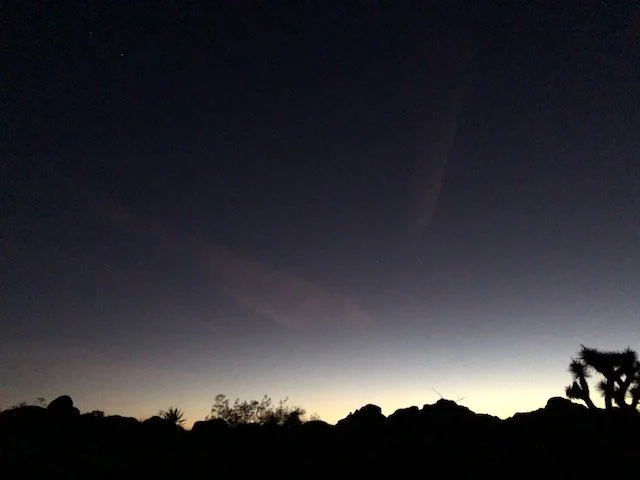
Picture was taken at a Joshua Tree National Park campsite during dusk; a yucca tree appears clearly—one sustainable source of life for Native Peoples.