Owners All
When I woke this morning in pitch charcoal-grey black outside, I felt a lightness. My steps were bouncy stepping bare feet across kitchen floor on my way to make coffee. What gives, I wondered? Boiling water, I poured on coffee grounds then edging up to a filter’s side and waited. The drips dropped slowly. Carrying a ceramic cup full on medium roast flavor and inspired depth-charge caffeine, I added whole milk for balance.
This morning in a 4 : 45 a.m. darkness I am going to visit my friend Pololu Valley and she always has a receive where I am so grateful to give. While there I own my womanly body and intuit how nature’s environment owns my adventure for the morning. My give is quiet respect and her give is infinite sensory support. Every body has a chance to be here (and always a privilege, still) and how I define my specific lesbian-woman body being here is in a give-receive nature vibration working.
What I receive is a grateful right to own my body in being conscious to spiritual goodness while on a nature discovery in Pololu Valley. What the land receives is a visitor’s respect and friendly joy vibes to honor being there—especially accurate while I am picturing local trees and sand and lava-rocks as spiritual material to embody ancient lives. I wave and say hello to all my nature companions on this level, a reciprocity in owning our individual energies.
Owning my energy even on a brief commute from a dwelling’s front door where I stay feels tutorial, another mindful chance to recognize my physicality: my stomach feels light, shoulders squared and strong, breasts floppy yet agile, gluteus maximus still has muscle, and my vagina feels spiritually sound. What many claim as my privates are energizing on how to own my grateful good health.
And conveys as public health because as each of us is physically healthy so is our community. Ownership of a word called lesbian to describe myself is how I claim public ownership of language (whether I see the language or not) and the process begins in my aware body. A healthy body brought to healthy nature is how we are owners all.
But if I had believed all the road signs I saw driving the way to Pololu Valley—Private Property, No Trespassing, Keep Out, Kapu—how doubtful I could be. What does owning my energy even matter? Why learn from nature how to be in give-receive reciprocity? All the land signage shows private economic dominance. All the signs signaled being shut out. Do I even have access to my own lesbian-body being comfortably free in nature’s abundance?
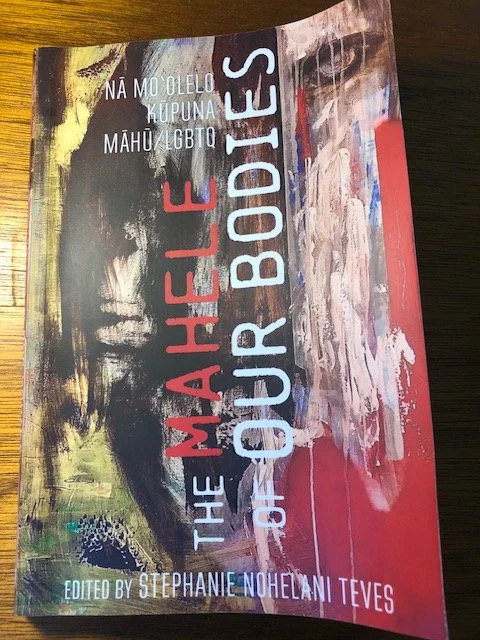
This is a question implied in a book Stephanie Nohelani Teves has authored Na Mo’Olelo Kupuna Mahu/LGBTQ, the Mahele of Our Bodies (2025). Teves is Kanaka Maoli meaning Native Hawaiian and teaches at University of Hawai’i at Manoa designing courses on Indigenous feminisms and queer theory. In her writing she celebrates the “glee of finally winning, and watching younger generations unhampered by the same colonial forces that shamed you” (Intro x). She weaves a clarity writing while interviewing ten kupuna (elders) who demonstrate how Hawaiian sovereignty has ownership potential to integrate LGBTQM strengths when in reciprocity to give-receive purposeful knowledges. Teves admits “in many ways this project was about my own history.”
A day in ancient history on these Pololu Valley Hawai’i lands had been where land had community purpose. Yet after extreme colonizing the changeover to private ownership can influence how individuals perceive physicality today. Question remains then: is my search for the word lesbian in Hawaiian history anachronistic, bringing a modern pov to a time when such a pov is not designed yet?
Teves provides historical context on “Hawaiian Sexuality,” again a modern phrase for antiquity. Sex in ancient Hawai’i connected people organically in a culture where living so attuned with environment in nature and spiritual energies built a continuum of sexual choice. When a female couple appeared in ohana (family) circles of labor—since labor defined every person’s role in ancient Hawaiian social structure—these women were organic to the wider cultural flow. No shaming.
And another sexual partner might be chosen later whether female or male, a sexual fluidity then. “Hawaiian pre-colonial society included an array of sexual practices and coupling arrangements, where what we call polyamory, bigamy, same-sex relationships, and other relationships were common” (Teves 7). Can my modern identity word lesbian be applied then on this routine Thursday afternoon September 17, 2026 to Kanaka Maoli living historically in Pololu Valley centuries ago?
What I can recognize is probably not. Yet generous intellect means I’m still in acceptance for learning Hawaiian history which teaches further how my lesbian identity includes generations of wisdom shared. I keep a modern word working for me and stay historically, curiosity open. For example, “Hawaiian culture has a history of gender fluidity and non-heteronormative sexual practices that can be traced back to antiquity” (6). Picture the volcano goddess Pele who has a sister Hi’aka repeatedly in mo’olelo, a story that “can be about the past and project a future” (Teves 5), while cultivating a relationship with her female lover Hopoe. Through this mythology a truth stories into popular culture.
Even basic concepts I harbor today on a couple’s relationship are revitalized knowledge wise through historical context:
Prior to European contact and influence Kanaka Maoli lived with a relative cultural understanding of customs and protocols related to relationships with the spiritual and physical environment…What we understand to be love or romance existed on a spectrum that included long-term coupling and intimate and platonic friendship, with monogamy being very rare. (7)
But once Christian colonizers infiltrated Hawaiian culture, religious ideology invasively demolished Kanaka Maoli ways to perceive sexuality.
Christian religious ideology declares fidelity marriage is the only model between a man and a woman and other sexualities are criminalized. Lasting on the legal books until 1972 when adultery and fornication are removed from the penal code (Teves 9). But historical contexts experience tumultuous changes, progressively enacting into law how peoples reflect on their private bodies having public rights no matter who you are. In 2013, “after 55 hours of public testimony, then Hawai’i governor Neil Abercrombie signed into law the Hawai’i Marriage Equality Act of 2013” (15). The word lesbian might be anachronistic when applied to Hawai’i history yet creatively if I decide to marry a woman, I can legally call her my lesbian wife. Language stays expansive across centuries to include our growing sense of selves, clearly.
Reading immersive in-depth research does not exclude active imagination. Envisioning how lesbians might have lived on historical, sacred lands is where I go while visiting Pololu Valley. Teves explains a way to achieve curiosity:
This book explores the experiences of Kanaka Maoli kupuna who identify as LGBTQM (2)…It is all of our kuleana [responsibility] to listen and remember that these voices do not need to compromise or choose between being Kanaka or LGBTQM. Instead, as these mo’olelo teach us, we are able to weave these parts of ourselves together and have it inform our lives in a way that is generative and fruitful. (147)
A key tenet I have been taught while living in Hawai’i is to live in accordance with give-receive nature patterns. And is reason why I find being way out there—imagination and land-resources wise—as method to keep learning how to be peaceful in the moment, in inquiry what my being useful looks like presently.
Aina (land) shows me a way. Staring at a lagoon this early morning declares so obviously how intuitive permaculture makes for a nature inlet to design lives lived thriving. Fresh water arriving from mountain ravines travels into a lagoon in the valley. Plants are grown, fish are nurtured, and a replenishing nutritional cycle continues to sustain human lives also nourished on spiritual practices to honor the surrounding land. Being useful in this here and now requires I simply experience environs through gratitude and serenity.
Way over at a lagoon side further back in the valley, I picture two women many centuries ago dipping gourds into fresh water for a purpose to be generative in their ohana. One leans over to kiss the woman who she adores in this specific moment and, historically, can I call the couple lesbian—unlikely, yet can I, Karolina, being a modern lesbian-woman nurture my own creative spirit in relying on this word? Powerfully so, yes.
And all other nature elements equally give this morning’s hiking adventure a power infusion. A gifted chance to be standing on Hawai’i land. Immersed in intuitive reciprocity to give and to receive organically. While living in a world where land is privatized ownership everywhere, I can use the word lesbian to ensure my body has public visibility, owning my energy, an integrity way to say she is me and I have a public right to own myself wherever I go.
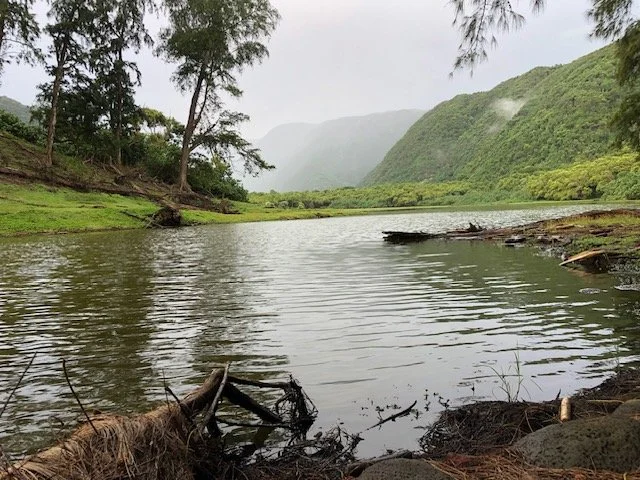
A fresh water lagoon in Pololu valley; the Pacific Ocean is several hundred feet behind.
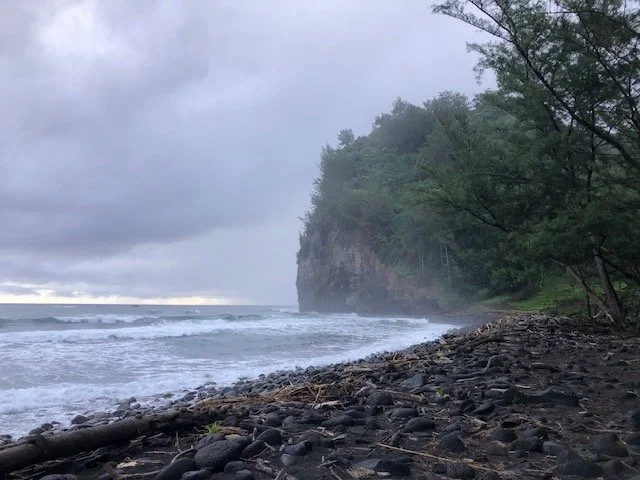
On a gray drizzly morning, the Pololu valley ocean cove still exudes powerful, peaceful vibes.
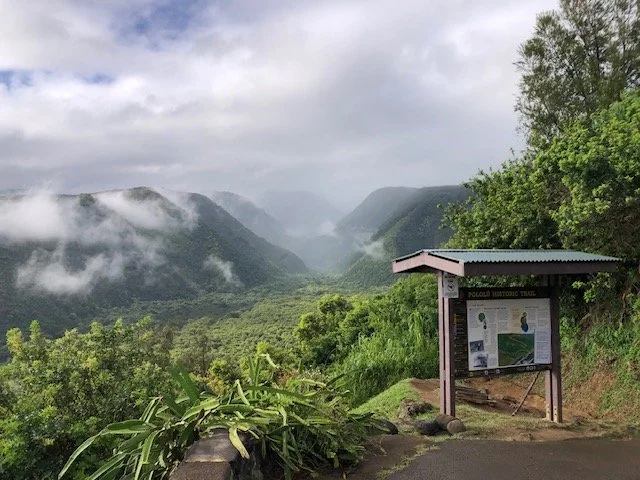
A view into the valley before trekking 1,000 feet alongside a worn cliffside path—reliable and diligent.