Birds of a Feather Flocking Together
One afternoon several years ago I began a hike from a house where I was then staying. Walking a steep hill on Hawi Road the incline has steep enough that I leaned forward and watched my feet for balance. During a half mile sauntering I saw small white feathers appear at my feet. Curious why I simply kept walking and observing and wondering what role white feathers have on a countryside road edge where tall grasses are the routine.
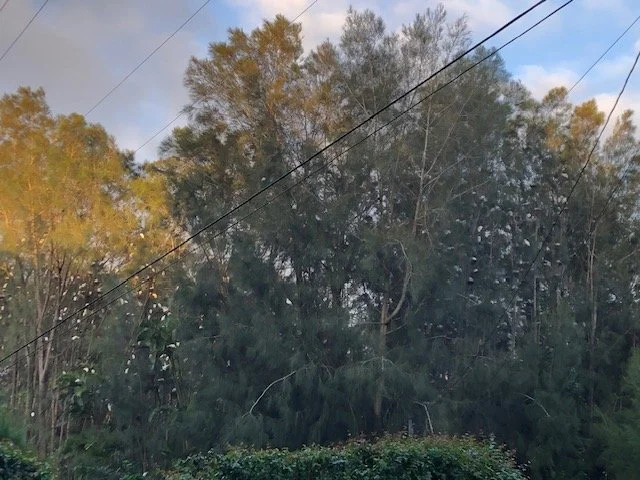
Where this mountain road plateaus evenly is when I heard a screechy, raucous volume. Many birds hollering somewhere and so I looked far beyond my usual visual line, way high above into a tight grove of ironwood trees. Lodging on tree limbs eight building stories skyward (one story is ten feet or so) are several hundred petite-sized white cranes. Walking closer to this grove of trees an intensive aroma of bird flotsam on land reaches your nose: stale, dusty, pungent and lively decomposing.
The area so distinctly enriches bird lives being lived, I’m taken aback at ferocity to make an energetic home. Quite a few years after walking that afternoon, today I drove alongside the exact same area and a grateful reminder returned. There is a precise reason why birds of a feather flock together.
What we have in common these birds and we humans is a willingness to be there for each other. To observe I parked my car on the roadside and leaning against a road railing, my feet crossed, I relaxed and craned (easy pun) my neck to gaze upward. I saw a thin twig in a bird’s beak. Back and forth birds continue carrying material enough to create a sturdy nest. Throughout the tree canopy are many dozens of condensed circular areas, which are the nests. Building each one is a flock’s mindset that for every crane to thrive a communal habitat creation needs to happen.
Where I had been returning from this morning was a sobriety habitat where one conversation twig at a time, we are willing to be there for each other. We flockers are in a health condition called addiction healing and are birds of a feather who fly together—or else we perish. Our most effective sobriety tool is one bird talking to another sharing addiction’s reality, a relatable lived experience. Only those who have truly flown this migratory route know.
Like the steep hill I walked that quiet afternoon long ago, today I continue to devote time for solitude that nourishes, meaning prepares me to be in honest conversation with another in sobriety. Finding hope in a recovery talk with another is the concomitant result. Conversations are a home nest for addiction healing. And when I achieve my self-work to spiritually relax for an hour during the day, I return to my conversation flock better able to be a bird of a feather.
Creating spaces and ways to have one-to-one conversations are based on simplicity—sharing truthful accuracy about our difficult past and optimistic present. Like the birds I saw today, we sobriety humans fly one after the next continually a “basic” conversation twig, which pads a landing base to rest sturdy. We call this being in “the rooms,” a conversation home that lasts for good if you decide to rest easy here. Getting there can be a miracle.
In the early 1930s a woman named Louis called her friend Ann to see if their husbands might have a conversation. Ann thought the idea was great yet at the time her husband Bob was passed out drunk under the kitchen table. How about the next day? When Bob and Ann walked into the home of Bill and Louis, the first meeting between Bob and Bill began a recovery conversation that continues today 85 years later and looking to last for good into the future.
That afternoon Bill shared his relatable alcoholic past with Bob, who understood all so well, and since then Alcoholics Anonymous has a foundation entirely based on one sober hopeful talking with another, a simplicity conversation to nest a recovery home called AA. Gratefully, Ann Smith and Louis Wilson, trusted their intuition to pair two alcoholics for conversation spoken in a language only Bob and Bill could understand having lived the addiction experience.
What remains true nearly a century after AA’s simple structure—one reciprocally, healthy conversation at a time—is that the work stays entirely, monetarily free. For sure money is collected as a suggested donation and channels through wide-reaching basic methods to support all of us in recovery. Yet at heart, sobriety program life remains free of money concerns since consumerism often prevents a supportive recovery conversation between two folks. Fatigued after exhausting hours earning money to purchase materials that can be far too many or much of what we might very well not need at all can eliminate enough time. We are too “busy.”
But cultivating personal quiet time for being useful during these conversations is a reliable daily sobriety goal. The first strategy to support a woman who begins sobriety is we give her our phone numbers to start a conversation, any conversation on how we can listen and be kind. We never know what loving words she might hear those first few days while in a severe disturbance called early recovery.
An easygoing, laughter infused conversation and in a money free space and democratic to the core, what’s not to choose and join? Thousands and thousands have, saving her own life and rebuilding connections in her relationship radius. Thousands and thousands choose otherwise and go in one dire direction for alcohol addiction is a health condition that is only progressively fatal. When I wonder why, I can see cultural factors might alienate a few needing sobriety help.
Right now I am working on a Lesbian Alkie Primer: the First 90 Recovery Days. Might I bring a language heard especially clear through the ears of my kindred lesbian tribe? Possibly. And still the AA way is for democratically all diversity, every specific demographic imaginable. Alcohol addiction does not discriminate: physical-emotional-mental results of a fatal health progression are similar for each culturally complex human being.
And explains why seeing all the cranes today—a relaxed Sunday after attending an AA meeting—had such an influence on my life. I realized that over the years a conscious effort to be what we call “a worker among workers” is being in the flock. Whenever I devote my time each day to effort that encourages thriving life for our recovery group, one conversation at a time, is a decision to continue giving back what really has been so freely given to me. And clearly demonstrates why a sobriety program that began in the 1930s is foundationally as strong today as 85+ years ago—each talk between two sobriety folks continuing the strength—birds of a feather flocking together.