Belonging: Political Nudity
Employed for many decades in an Insult-Factory continually believing if-only I accepted the next one—a derogatory signal, word, person, phrase, moment, situation, scenario, staging or attack—then the process might end. Core misunderstanding has been that my days were meant to be symbolically gainfully employed in life this way. We women often call this survivor mode. Yet authentic life is never going to work deflecting organized difficulty. How then might a thriving life each day look?
Gladly, a few days ago, I retired permanently from ever accepting work in the Insult-Factory again. In every moment remaining in my life a new employer I call Spirit-Guide, an energizing spiritual source, ensures I have my best intuitive-skill to respond healthy well if a next insult occurs. Being consciously empowered this way begins in my lesbian body. And who is she?
A woman stands at a distance hearing a question: has she made coffee and can she bring? Experimental filmmaker Barbara Hammer recalls being asked this familiar patriarchal question which she saw through symbolic bifocal glasses near and far perspectives how the men around her perceived. Closeup she was a sexual being. And once distant from her objectified role she was a domestic helper.
Epiphany is fleeting and flimsy if action not taken. Hammer’s new life began when leaving her former one, being married to a man, in her distant pov. She chose to change her life based on her revolutionized symbolic glasses. Her seeing close up how sexuality with a woman electrified her feelings and the women’s emotional depth together. Best yet was not being expected to chase domestic chores like making coffee afterwards. She could put down for good her symbolic bifocal glasses to decode heterosexism.
Creating thousands of experimental film clips in her career’s decades, during one she places a gold-rimmed crystal-clear pair of glasses on her pussy. Humorous and sensual and political and visual without having to say a word: how she now saw her lesbian self, a declaration to own her life-perspective entirely.
Her first female lover also drove a motorcycle like her prior husband even while the newly lesbian couple traveled across Europe rather than the US. In a direct appeal then to the camera, Barbara asks, has her life-view been radicalized. The question recurs in her history-making oeuvre of art all throughout: will her camera creatively evoke how feeling lesbian sensuality influences all her life reactions?
This summer on a Thursday evening June 26 I stood on the Castro Street sidewalk in a crisp, cold San Francisco wind with two warmly new friends. Waiting in line we were to see the documentary Barbara Forever. Even though I had just met these women an hour before, we still shared a lesbian hug that had erotic charge full of being grateful to be lesbian alive. Note that I did not write sexual. Not just a physical sensation which is often the goal of contact for contact’s sake.
Rather we three lesbian women had feeling to humbly, powerfully realize our energetic place being privileged to touch easily in public. Our hug on Castro Theatre’s outside compares to publicly viewing intimate lesbian sex on the political film screen inside. Healthy, spirited awareness equally dynamic across one spatial continuum.
Springing into view on my sidewalk left was filmmaker Jenni Olson. Standing a few folks over was Barbara Forever documentary director Brydie O’Connor jostling and hugging Hammer’s life partner of 30 years, Florrie Burke. A photographer had this group gather the seven or eight into a pose. Photos taken and the creatives disbanded. In this moment I recognized a few strong women—even while not knowing specifics who she was—seen through my gaydar lens. Bifocals not necessary since I look through this one lens. Later when I saw the women on the Castro Theatre stage to introduce the film, I learned who the women were. Gaydar intuition accurate again.
Filling the sidewalk line was female diversity, a jazzy lesbian eclectic while all of us were watching ourselves. One essay in her book Sister Outsider: Essays and Speeches (1984) describes “only now, I find more and more women-identified women brave enough to risk sharing the electrical charge without having to look away, and without distorting the enormously powerful and creative nature of that exchange.” This is Audre Lorde writing her essay “Uses of the Erotic: The Erotic as Power” in 1978. How contemporary the words feel.
Taking to the modern streets is always consciously political. On a public sidewalk this early evening crowding ourselves in a kindred-spirit tribe, what kept vibing is this is still democracy. In a US fascist political milieu, having access to celebrate our lesbian bodies still rings true in America. Barbara Hammer wanted we women to see our naked lesbian selves and from this viewing empower our feelings, our spirits to return streetside further politically riled: speak up, live strong, and take action. Lorde declares that “within the celebration of the erotic in all our endeavors, my work becomes a conscious decision—a longed for bed which I enter gratefully and from which I rise up empowered.”
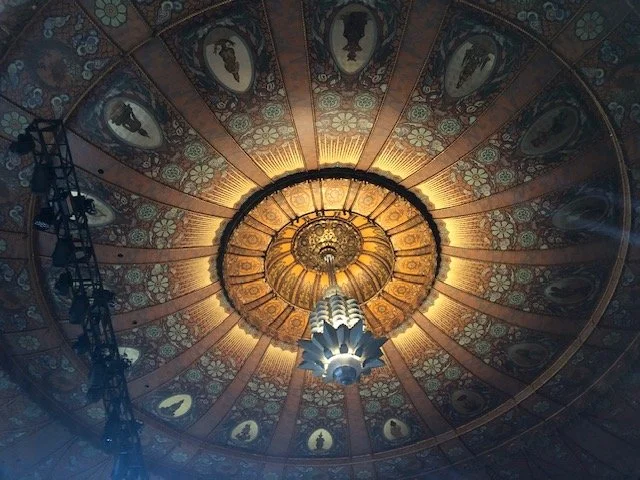
Consciousness-raising social connectivity often derives from aesthetic beauty. Experiencing a Castro Theatre film viewing many times over the last decades, this night I was to see a brand-new interior renovation. Expectations usually lead awry, yet I still brought highly-curious anticipation. What might I discover? A few first steps towards where we find our seats what greets instantly is the 1930s Art Deco ceiling glowing incandescent light rays streaming from the central chandelier. Industriously detailed renovation work achieved now after several years and millions of dollars invested brings event enjoyment and gratitude for all we in tribal public sphere.
Standing in the restroom with a few others at a marble sink lightly rinsing my hands, I said to a newly befriended woman, the hugging one, “this place is amazing!” Consider a free-wheeling concession stand serving homemade popcorn and beverages with a kick and those in a sobriety realm like I need. Picture comfy theater seats that are also portable, opening this venue’s offerings to entertain a film crowd or a music concert.
Since 1978 the Castro Theatre’s music signature has been organist David Hegarty playing springly light yet soulful notes from organ pipes. Bringing in the new alongside architectural renovations is a one-of-a-kind in the world organ to entertain crowds musically through traditional organ piping paired with digital organ creativity in one sound-force location. Hegarty designed the Castro Symphonic Theatre Organ to accent the spatial acoustics. On another visit I hope to hear since this evening a musical signature was still in the offing.
Feminist adage always holding true that the personal is political. Barbara saw the world through a camera lens all her artistic life. Audre Lorde was born five years before her and these lesbian women generationally aligned knew how living a daily truthful life was the lens for sending a political message. Lorde describes how “our erotic knowledge empowers us, becomes a lens through which we scrutinize all aspects of our existence, forcing us to evaluate those aspects honestly in terms of their relative meaning within our lives.”
O’Connor’s powerful documentary talent now ensures Hammer’s experimental films, a persuasive ethos—has staying power. Empowering erotic lesbian knowledge now has historical longevity through her documentary Barbara Forever. Since the personal is political then deep modern gratitude for artists who proactively contextualize the lesbian personal as political like Hammer, Lorde, and O’Connor.